
Please click here to donate to the Simon Balle All-through School Fund. We thank you for your contribution which will support the provision of educational excellence and enrichment for all our students and help in "Creating Tomorrow's Citizens Today".
Simon Balle All-through School Logo

Simon Balle All-through School

Creating tomorrow’s citizens today

  • Community
    • Co-headteachers’ Welcome
    • Primary Welcome
    • Welcome to Simon Balle Sixth Form
    • Why choose an all-through school?
    • Vision, Values and Expectations
    • Ofsted
    • Staff List
    • Governors
    • Equality
    • Environment and Sustainability
    • Safeguarding
    • Online Safety
    • Parent Staff Association (PSA)
    • Student Leadership
      • Informed Magazine
    • Partners
    • Professional Development
    • Vacancies
    • Get into Teaching
    • School Fund
  • Curriculum
    • Curriculum Subjects Overview
    • Curriculum By Year Group
    • Pastoral Structure
    • Teaching and Learning
    • Home Learning
    • Remote Learning
    • Artificial Intelligence
    • Assessment
    • Careers
    • Enrichment at Simon Balle All-through School
    • Duke of Edinburgh Award Scheme
    • Examinations
    • Library
  • Admissions
    • Primary, Secondary and Sixth Form Open Events 2025
    • Why choose an all-through school?
    • Primary Admissions
    • Secondary Admissions
    • Year 6 into 7 Transition
    • Welcome to Simon Balle Sixth Form
    • Year 7 Music Aptitude Admissions for September 2027
  • Daily Life
    • Communication and information platforms
    • Attendance
    • Calendar of events
    • Catering
    • Devices
    • Equipment
    • Home Learning
    • Our Musical School
    • Online Payments
    • Pastoral Structure
    • Remote Learning
    • Rewards and Consequences
    • Welcome to Simon Balle Sixth Form
    • Sport
    • Term Dates
    • Times of the Day
    • Travel Plan
    • Uniform
    • Wellbeing & Mental Health
  • Inclusion
    • Inclusion – “a great education for every child”
    • SEND
    • Pupil Premium
    • 16-19 Bursary
  • What’s on
    • Newsletters
    • Calendar
    • Music
    • Sport
    • Enrichment at Simon Balle All-through School
    • Primary, Secondary and Sixth Form Open Events 2025
  • Policies & Accounts
    • Policies
    • Financial Information
  • Student Outcomes
    • EYFS Outcomes
    • KS1 Outcomes
    • KS2 Outcomes
    • Primary Outcomes in Foundation Subjects
    • GCSE Outcomes
    • Post-16 Outcomes
    • Destinations
  • Contact
    • Contact details
    • Emergency Closure
    • School Grounds
    • Facilities for Hire
The Elm Sport Centre
Simon Balle All-through School Logo
  • Community
    • Co-headteachers’ Welcome
    • Primary Welcome
    • Welcome to Simon Balle Sixth Form
    • Why choose an all-through school?
    • Vision, Values and Expectations
    • Ofsted
    • Staff List
    • Governors
    • Equality
    • Environment and Sustainability
    • Safeguarding
    • Online Safety
    • Parent Staff Association (PSA)
    • Student Leadership
      • Informed Magazine
    • Partners
    • Professional Development
    • Vacancies
    • Get into Teaching
    • School Fund
  • Curriculum
    • Curriculum Subjects Overview
    • Curriculum By Year Group
    • Pastoral Structure
    • Teaching and Learning
    • Home Learning
    • Remote Learning
    • Artificial Intelligence
    • Assessment
    • Careers
    • Enrichment at Simon Balle All-through School
    • Duke of Edinburgh Award Scheme
    • Examinations
    • Library
  • Admissions
    • Primary, Secondary and Sixth Form Open Events 2025
    • Why choose an all-through school?
    • Primary Admissions
    • Secondary Admissions
    • Year 6 into 7 Transition
    • Welcome to Simon Balle Sixth Form
    • Year 7 Music Aptitude Admissions for September 2027
  • Daily Life
    • Communication and information platforms
    • Attendance
    • Calendar of events
    • Catering
    • Devices
    • Equipment
    • Home Learning
    • Our Musical School
    • Online Payments
    • Pastoral Structure
    • Remote Learning
    • Rewards and Consequences
    • Welcome to Simon Balle Sixth Form
    • Sport
    • Term Dates
    • Times of the Day
    • Travel Plan
    • Uniform
    • Wellbeing & Mental Health
  • Inclusion
    • Inclusion – “a great education for every child”
    • SEND
    • Pupil Premium
    • 16-19 Bursary
  • What’s on
    • Newsletters
    • Calendar
    • Music
    • Sport
    • Enrichment at Simon Balle All-through School
    • Primary, Secondary and Sixth Form Open Events 2025
  • Policies & Accounts
    • Policies
    • Financial Information
  • Student Outcomes
    • EYFS Outcomes
    • KS1 Outcomes
    • KS2 Outcomes
    • Primary Outcomes in Foundation Subjects
    • GCSE Outcomes
    • Post-16 Outcomes
    • Destinations
  • Contact
    • Contact details
    • Emergency Closure
    • School Grounds
    • Facilities for Hire
Simon Balle All-through School Logo
  • Community
    • Co-headteachers’ Welcome
    • Primary Welcome
    • Welcome to Simon Balle Sixth Form
    • Why choose an all-through school?
    • Vision, Values and Expectations
    • Ofsted
    • Staff List
    • Governors
    • Equality
    • Environment and Sustainability
    • Safeguarding
    • Online Safety
    • Parent Staff Association (PSA)
    • Student Leadership
      • Informed Magazine
    • Partners
    • Professional Development
    • Vacancies
    • Get into Teaching
    • School Fund
  • Curriculum
    • Curriculum Subjects Overview
    • Curriculum By Year Group
    • Pastoral Structure
    • Teaching and Learning
    • Home Learning
    • Remote Learning
    • Artificial Intelligence
    • Assessment
    • Careers
    • Enrichment at Simon Balle All-through School
    • Duke of Edinburgh Award Scheme
    • Examinations
    • Library
  • Admissions
    • Primary, Secondary and Sixth Form Open Events 2025
    • Why choose an all-through school?
    • Primary Admissions
    • Secondary Admissions
    • Year 6 into 7 Transition
    • Welcome to Simon Balle Sixth Form
    • Year 7 Music Aptitude Admissions for September 2027
  • Daily Life
    • Communication and information platforms
    • Attendance
    • Calendar of events
    • Catering
    • Devices
    • Equipment
    • Home Learning
    • Our Musical School
    • Online Payments
    • Pastoral Structure
    • Remote Learning
    • Rewards and Consequences
    • Welcome to Simon Balle Sixth Form
    • Sport
    • Term Dates
    • Times of the Day
    • Travel Plan
    • Uniform
    • Wellbeing & Mental Health
  • Inclusion
    • Inclusion – “a great education for every child”
    • SEND
    • Pupil Premium
    • 16-19 Bursary
  • What’s on
    • Newsletters
    • Calendar
    • Music
    • Sport
    • Enrichment at Simon Balle All-through School
    • Primary, Secondary and Sixth Form Open Events 2025
  • Policies & Accounts
    • Policies
    • Financial Information
  • Student Outcomes
    • EYFS Outcomes
    • KS1 Outcomes
    • KS2 Outcomes
    • Primary Outcomes in Foundation Subjects
    • GCSE Outcomes
    • Post-16 Outcomes
    • Destinations
  • Contact
    • Contact details
    • Emergency Closure
    • School Grounds
    • Facilities for Hire
The Elm Sport Centre

Assessment

Curriculum Subjects Overview
  • Business
  • Early Reading
  • Computer Science
  • Creative Arts
  • Drama
  • Economics
  • English
  • Film
  • Food
  • Geography
  • Health and Social Care
  • History
  • Maths
  • Modern Foreign Languages
  • Music
  • PE
    • Sport Premium (Primary)
  • Politics
  • Philosophy Religion & Ethics
  • PSHRE
  • Psychology
  • Science
  • Sociology
  • Assessment
  • Teaching and Learning
  • Library
    • Overdue books
  • Learning to Read; Reading to Learn

High quality assessment is an essential part of what teachers do in the classroom.  From a simple question and answer session to check if students are ready to move on in their learning to a formal examination, teachers are constantly gathering information about their students.  The information they gather has a number of uses:

  • to help teachers plan
  • to let teachers and students understand where they are in their learning and how to move on
  • to monitor and track progress
  • to trigger intervention
  • to provide information for parents

We use Arbor to report this information to parents and students throughout the year, with live data constantly available, and written reports published at set times in the year. 

For KS3 subjects progress data will be collected at two points in the year and (for most subjects) be based on a formal in-class assessment. It will be communicated to parents via Arbor

Assessing students in the primary phase

Our intended curriculum is broad and ambitious. Through ongoing and formative assessment, we adapt the pace of the curriculum to ensure that it is sufficiently challenging and supportive for cohorts of students, identified groups of students and individuals. Our aim is for all children to access all elements of their learning and to interleave knowledge so that it is understood, remembered and applied in the longer term. 

We assess through: 

  • Daily questioning and discussion.
  • Daily feedback and marking. Where this can be on the spot we believe that this maximises impact. Same-day interventions are provided to support individuals to secure their knowledge and understanding. 
  • 1:1 reading, especially in Reception – Year 3.
  • Challenges, which the children enjoy, which allow staff to pinpoint precise next steps. This begins from the very beginning of Reception – for example, phonics assessments – and continue throughout the primary phase – for example, with times tables, spelling and dictation, and destination questions in mathematics which require children to apply their learning to a next step.
  • Whole-class teaching: with maths fluency teaching (how much can be quickly recalled, explained and applied), and with the whole class teaching of reading (regularly reminding children of what they need to answer retrieval questions, or to summarise or to infer, for example). The emphasis is on children ‘keeping up’ with expectations in order that they are provided with the best opportunities and choices as they grow.
  • Checking how well the intended curriculum has been implemented and subsequently understood and remembered. This is crucial across every subject – rewinding, for example, previous science or geography or art content, to build new knowledge on secure foundations. The Simon Balle all-through curriculum maps for each subject ensure that teachers make explicit links to prior knowledge. You can see any of these by clicking on the relevant subject in the menu on the right hand side.
  • Termly assessments. These vary according to phase (age), but include more formal testing – supporting children to acquire skills for written reading comprehension and mathematical reasoning across a wide range of areas/topics. Writing is assessed over time where children are supported to be increasingly independent in their decisions for content, structure, grammar, punctuation and spelling. Writing is important in all subjects as well as explicitly taught in English. The purpose of termly assessments is to compare students’ progress and attainment with that targetted for each individual, based on performance at the end of the previous key stage, and high expectations and aspirations. Each term’s assessments leads to pupil progress meetings in which each student is discussed to determine any change in provision. 
  • Statutory and national assessments: 
    • Early Years Foundation Stage Profile (end of Reception)
    • Year 1 national phonics screening
    • Year 2 Key Stage One (KS1) SATs (reading; writing; mathematics; grammar, punctuation and spelling)
    • Year 4 multiplication tables check (being introduced 2020-2021)
    • Year 6 Key Stage Two (KS2) SATs (in subjects as above for KS1).

Put simply, assessment is there to ask how well the curriculum is being taught and learned. This process is integral to the teaching itself.

KS3 Grading Scheme (Years 7-9)

https://cdn.realsmart.co.uk/simonballe/uploads/2024/09/24132725/KS3-Assessment-Reporting-Process-Google-Slides-9-July-2024.mp4


How do we generate targets?

When your child enters Year 7, we receive their KS2 data, which is then used by an independent external data specialist to generate targets for Year 11. We plot an expected progress trajectory from KS3 into KS4, known as a flightpath, which helps us set benchmarks for each subject. These benchmarks guide us in assessing both knowledge and skills throughout KS3.

Each department sets specific benchmarks for grades using KS2 data and KS4 expectations. Our assessments are based on the curriculum, focusing on essential concepts and skills. Over the three years of KS3, your child will develop a deeper and more sophisticated understanding of these areas.

Benchmarks are detailed using percentages to define each grade. An example of this may be that a student who was able to attain a KS2 score of 106 might generate a target grade of 7 at GCSE. Our flightpath would indicate that this student should aim to maintain a performance level around 70% or above in their assessments to reach their potential KS4 grade. 

How do we report to parents?

Attainment indicates the current level at which your child is performing, reported as a percentage. It reflects the knowledge and skills demonstrated by your child at this stage. 

Progress measures whether your child is on track to make expected progress, reported using a colour-coded system. Red indicates significantly below expected progress, yellow indicates slightly below expected progress, green indicates being on track, and purple indicates accelerated progress.

How do we assess in KS3?

We have two major ‘data drops’ throughout the year, coinciding with assessment weeks. You can find this data on Arbor. The data will outline levels of attainment (percentages) and progress (colours), providing an accurate reflection of your child’s consistent effort and knowledge acquisition over time.

Assessment in Year 9

Despite a small number of subjects starting GCSE course content in Y9, students in year 9 will still see grades reported in percentages (as stated above).

Assessing students at GCSE

Class teachers will use GCSE grades (9-1) to report on student attainment. Please refer to the assessment and reporting schedule for the dates of assessments.

Assessing students at A level

Class teachers will use A level grades (A-E) to report on student attainment. Please refer to the assessment and reporting schedule for the dates of assessments.

Assessment Maps

Year 7 Assessment Map

Year 8 Assessment Map

Year 9 Assessment Map

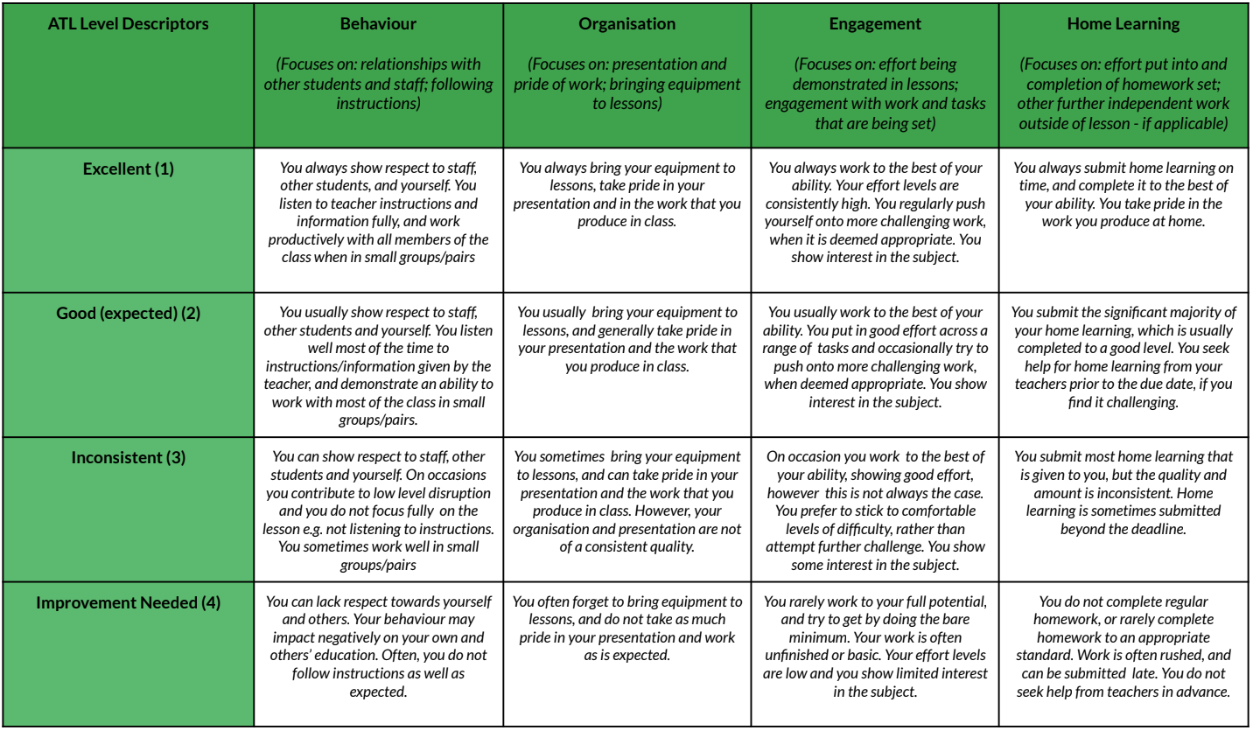
Report Cards

From September 2024 student report cards will be produced in and distributed via Arbor. These will consist of a numerical system to report on each student’s performance across a range of attributes: engagement, organisation, behaviour and home learning. The wording of the descriptors for this system is below.

Each subject will also provide a short ‘next steps’ target. This can be considered to be a main area that the student needs to focus on: more specific feedback is given in lessons so that it can be actioned immediately.
In this Area

  • Business
  • Early Reading
  • Computer Science
  • Creative Arts
  • Drama
  • Economics
  • English
  • Film
  • Food
  • Geography
  • Health and Social Care
  • History
  • Maths
  • Modern Foreign Languages
  • Music
  • PE
  • Politics
  • Philosophy Religion & Ethics
  • PSHRE
  • Psychology
  • Science
  • Sociology
  • Assessment
  • Teaching and Learning
  • Library
  • Learning to Read; Reading to Learn
Simon Balle logo

Simon Balle
All-Through School

Simon Balle All-through School, Mangrove Road,
Hertford, Herts, SG13 8AJ

01992 410400

admin@simonballe.herts.sch.uk

  • Cookies
  • Arbor
  • Involve
  • Leave of absence request
  • OFSTED
  • Parent Pay
  • Parent Portal
  • Staff Home
School website powered by Realsmart Logo